Showing posts with label guest. Show all posts

Monday, 5 February 2024

Guest Post by Lydia Baker: Writing an apocalyptic world and the theme of family

 Writing an apocalyptic world and the theme of family

Thank you so much for having me on your blog, Kate. My sci-fi novel, AVA, takes place in a futuristic city that mirrors London but could be any big city. Ava and her fellow humans have been trapped under an electrical barrier that appeared fourteen years ago when Ava was a child visiting the city with her father and brother. As a young adult, her determination to escape the barrier and discover if her family has survived drives her. But the things that wait for her on the outside are beyond anything she could have imagined. The novel follows the themes of family, self-sacrifice and self-discovery. 

One of the beauties of writing an apocalyptic world is that you can create a plethora of problems for your main characters so you can explore many different themes. Ava is separated from her mother and twin sister, something that her father struggles to deal with and eventually the grief of the loss and not knowing overcomes him. The loss of her father is detrimental to Ava. He was her protector and without him, Ava is left with her brother, who was adopted but is resentful of his sisters that are his parent's biological children. This theme of family plays out in the relationship between Ava and her brother with the distrust and betrayal that clouds their friendship and the abuse her brother deals out to her. 

Without giving too much away, Ava faces the ultimate betrayal from her brother when she escapes the barrier. On the other side, she is faced with the family she lost and struggles to work out her place with those she thought she had lost, as it had been fourteen years since they saw each other. 

Growing up inside the barrier, oppressed and hiding her gender to save it, has changed and warped Ava's character. Her loyalty is skewed and she struggles to accept that her family has moved on or to trust others. The family she left behind, that she has risked everything to find, isn't the one she has been imagining. Eventually, she comes to realise that the world is bigger than her, it is more than just her pain and she can make a difference—the most important difference.

Ava grows considerably during the novel. She goes from a somewhat immature young woman, only thinking of herself, to someone who knows that though it means giving up everything she can save those who mean the world to her, those she loves. I wanted to show the development of character through the growth of Ava and the shedding of her naivety. Something we all have to do as we grow and experience the world. I also wanted to explore how the world can shape us through Ava. There are some stark differences between her and the family she finds on the outside, who weren't oppressed by MTech (the controlling government) yet have still had to face equally terrifying dangers. Their attitudes are very different. 

As well as the more serious themes, AVA is full of twists and thrills, fighting and exploring. If you like a fast-paced, dystopian, sci-fi novel with a determined yet flawed female protagonist then please check out AVA! Thanks again, Kate, for having me on your blog. 

Lydia Baker is an author of science-fiction and fantasy, she loves to write novels you can escape into.

Her novel ‘The Return of the Queen’ won the Pink Heart Society Reviewers Choice Award for Best Paranormal/Fantasy Romance in 2019 and ‘Ava’ was Shortlisted for the Agora Books - Work in Progress Prize in 2019. Her short story A.R.C is featured in the Fantasy and Science Fiction Writers Alliance Anthology, 2023.

When she’s not writing she loves to read, run and crochet (not all at the same time though!). She lives in Crawley with her husband and four children.

AVA by Lydia Baker:

First, they came for the city, and we allowed it. They put up the Barrier and we stayed quiet, silenced by the fear of what was beyond. Our elderly were next and still, we didn’t cry out; then they came for the women, removed their fertility and stole our future, so I hid. I became Alec and I turned my back on my true self, Ava.

Ava can’t live as Alec any longer, the lie is killing her, destroying all that she is.

The world beyond MTech’s Barrier calls to her and she can’t ignore it. She has to know what, if anything, survived the terrible day that tore her family apart fourteen years ago.

But what if the Outside is far more dangerous than anything Ava has ever faced on the Inside?

Ava is set in a dystopian future, where individual rights are being eroded and the population live under a dome barrier that they have been told is for their protection. But, what is outside? Is escape possible? Even if it is, will it be a death sentence?


Thursday, 17 October 2019

Guest Author at Literary Edits

Today I have been interviewed as a guest author over at Literary Edits.

You can read my interview here: Guest Author Kate Kelly.

While you are there do check out the author services they offer - from editing and proofreading to reviewing and helping with marketing. The reviewing is free, of course, but I think you'll find all their other services very competitive.

Friday, 27 April 2018

Guest: Children's Author Cherry Cobb

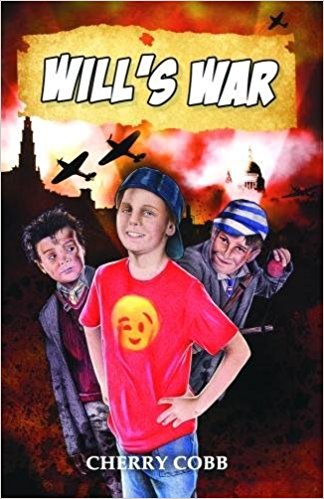
Today's guest is Cherry Cobb. Her debut children's novel, Will's War, has just been published by Candy Jar.


Will is an ordinary boy who likes to build Lego models, and play with his dog Rollo. But after a stupid row with his mum he ends up at his grandad’s house, where he discovers an old air raid shelter. Will steps inside to investigate, but when he comes out he is not in his grandad’s garden but in Second World War London.
How will he get back?

Hello Cherry, Welcome to the Scribbling Sea Serpent and congratulations on publication of your debut children's novel, Wills War. 

It’s lovely to be here, thank you for inviting me and giving me the opportunity to talk about my book.

To start, please tell us a bit about your new book.

Will is an 11 year old boy who finds an air raid shelter at the bottom of his granddad’s garden, he goes inside to investigate and is transported to WWII London in the middle of an air raid. His mission is to get back home, but before he can he finds himself evacuated to the country.

Tell us a bit more about the abandoned village that inspired Will’s story.

I have always been interested in WW2 and living close to Dorset I was able to visit Tyneham Village. It is a ghost village abandoned in 1943 during the Second World War. The church and the schoolroom are still standing. It feels like the place time forgot, a great place for imagination and inspiration. I have also been to various museums where you can go into an Anderson shelter. Where families spent many hours together often during the night. You get a feeling of just how hard life was during the war. Both places inspired me to put pen to paper, I just started thinking What if?


Being transported back in time must have been quite a shock. Can you give us some examples of the things Will found it hardest to relate to?

There was lots of things Will found difficult, from the devastation in the streets to the blackouts and having to take a gas mask everywhere. He also hated the air raids and was amazed to find that people could sleep through them. Will was also astonished by the lack of common appliances in homes such as a toaster or a television.

Setting a story during WW2 must have involved a lot of research. What was the most unusual or surprising thing you discovered? 

I really enjoyed the research and learnt a lot. As a mother myself I was drawn to the information around Operation Pied Piper on the 1st of September 1939 when the Government decided to evacuate civilians from the cities. At London’s main stations a train left for the country every 9 minutes for 9 hours. In total 1 .5 million people were evacuated in 3 days.

If I suddenly found myself transported back in time into the middle of an air raid what advice would you give me? 

Well firstly to take cover as quickly as possible, and wait for the all clear. Secondly, to join in with an activity such as a singsong, to boost morale and keep fear at bay. During the raids people would play cards or other games, or read if the light was good enough. People suffered air raids for many years and had to find ways of combating boredom and anxiety on a daily basis.

What was your journey to publication like?

I bought a copy of the Children’s Writers and Artists yearbook and sent off the first three chapters and a synopsis of Will’s War to various publishers that I thought might be interested in the book. I then waited as you do, for quite some time, just as I was beginning to think I might have to send out a second round I received a reply from Candy Jar Books saying that they liked the concept and would like to see more.  That was the beginning of my journey to becoming a published author. I’m still doing the happy dance and in between pinching myself to make sure it’s real.

Will we be meeting Will again or do you have something different in the pipeline?

I have been working on a new book, but I am drawn to write another adventure for Will. Watch this space!

Thank you Cherry for answering my questions and I wish you all the best with Will's War which can be purchased from Amazon UK and from all good bookshops.

Cherry Cobb lives in Somerset with her family and two cats. As a former lecturer she appreciates the importance and value of children’s literature. She has won several poetry competitions blaming the success on her wild and vivid imagination. The idea for Will’s War came about one day when she visited a ghost village evacuated in 1943 during WWII. She is never without a notepad and pen and a head full of ideas.

Thursday, 4 January 2018

Creating a Sense of Place: Guest Post by Kathy Shuker.

Today my special guest is Kathy Shuker, a Devon based author who writes intriguing mysteries with an evocative sense of place. Welcome to the Scribbling SeaSerpent, Kathy.

I’ve been writing novels now for around fifteen years. Most of the early ones never saw the light of day (fortunately) but three have been published and many readers have commented on their strong sense of place. It’s been a long learning curve and here I’ll try to share what I’ve learnt and how I approach the setting for a story - and why I think it’s important.

Writing a novel, I quickly found out, involves endless decision-making - there are so many different ways to tell a story. If you’re indecisive like me, it can slow you down; you become literally spoilt by the choice. And it’s all too easy to get wrapped up thinking of exciting plot details or complex characters and neglect the all-important background information. Along with the time period, the setting is fundamental to the atmosphere of the work. For example, if you want to tell a story that’s hard and fast and clean-edged, brisk with people and the insistent thrust of modern life, you would probably set it in a big city. If you want a moodier story with a haunting backdrop, you might choose something rural and remote. Again, there are many options. Whatever you choose, the setting is like another character in the story, something that has an essence of its own and, if it’s to play its full part, needs to be respected as such.

I write mysteries which are character-driven, stories that revolve around small communities, families with untold back stories, groups of old friends whose relationships have grown or stretched out of shape or have even broken down. I feel they suit intimate and sparsely populated settings. There’s time for the characters to interact; there’s space for the unusual, the surprising, the unspoken, all of which add to the mystery. I have spent most of my adult life living in rural areas so my choice of settings is not surprising: I know how small communities work; I breathe more easily in the countryside. And I think that’s an important factor in choosing a setting for a novel: you need to know and understand where the story takes place. It’s going to be a long writing journey and that setting is going to hold it all together. As the story unfolds, it will keep throwing questions at you - points of detail which, if you get them right, can help to make the story credible. If you get them wrong, the reader may pick up on the inconsistencies and be pulled out of the story.

So, what do you need to know about this place you have created? I use real settings but subtly alter them to suit my story and I use fictional names. Wherever you choose to set the book, you need to research it as you would the other characters. You may not use all that information but you need to know it. Firstly, you need to know what the place looks like - how it’s laid out; what the architecture is like; what the buildings are made of. If it’s rural, you should find out the species of trees and flowers that grow in the area. Is it barren or fertile? What is the climate like? And you may need to know the times of sunrise and sunset. I always keep a diary to hand for that. And, since a previous book and the one I’m currently working on are both set by the sea in the UK, I have to know the tide times for the period I’m writing about too. Though you don’t have to live in the place the book is set, it does help if you have at least visited it. A lot of really useful information can be found in books and on the internet but there’s no substitute for first-hand experience.  My second novel is set in Provence. I’d been lucky enough to have visited the area several times before writing it which enabled me to remember the piercing brightness of the sunshine, the oppressiveness of the mid-summer heat and the way storms can develop and pass quickly leaving the ground suddenly washed and sparkling again. Information like this can give the story more depth and life.

But looks aren’t everything. It’s important to describe sounds too, and smells - very emotive - and the feel of something to the touch. Every little nudge of information can help to produce a more rounded and three-dimensional image. And do it slowly. As a reader, I know how easy it is to switch off if too much information is presented in one go. When I’m writing, I give a brief overall description initially then drop more crumbs of detail in as I go along. Sometimes a single adjective, well-placed, can be more effective than a whole paragraph. And don’t forget to leave some leeway for the reader’s imagination; that’s part of the pleasure of reading. ‘Less is more’ is a mantra I often say to myself!

Above all I think you should enjoy your setting, have fun with it, inhabit it for the duration. If you can believe in it yourself, your readers will too.


Kathy trained as a physiotherapist but a back injury forced her to change career. She studied design and worked as a freelance artist, painting in oils and watercolours, exhibiting and teaching, before starting to write. She now writes full-time. As well as a continued love of reading, Kathy is a keen amateur musician, singing in a local choir and playing guitar, piano and fiddle. Art, the natural world and conservation are also particular interests. She lives with her husband in Devon, UK.

Kathy’s books are available in digital and print format on multiple platforms.

Kathy's Wesite
Kathy's Amazon Page
Kathy's Facebook Page

Monday, 4 December 2017

Self Publishing: Pitfalls and How to Avoid Them - Part 2 (Guest post by Celia Moore)

Having self-published my debut novel Fox Halt Farm, I thought I’d share a few more of the mistakes I made. I talked last week about my cover (here is the post if you would like to start at the beginning).

I hope this might save other indie authors time, money and worry.

3. The interior design is crucial too

I watch when people pick up my book. All pause on the cover and I always expect them to turn it over to read the back – just like I would but some don’t, some people flick the pages – some read the dedication, some wade through a random paragraph of text. I find it fascinating trying to imagine what they are thinking and how they are judging whether they will enjoy reading my novel.

I love a thick book with an intrinsic plot to savour – I want to be taken to another place and live there as long as possible, I don’t want the end to come, so it’s important that the book is thick and the font isn’t too large – but not so tiny or faint that I am going to struggle to read it. There are fonts I dislike too, the type must easy to read.  I want a simple layout but I can be impressed when the chapter titles reflect the cover design.

What I am saying is, you have to consider not just what you are saying and the way you are saying it but the actual interior design is vital too.

I changed the dimensions of my book and reduced the font size by 0.5 so its thickness didn’t feel uncomfortable to hold. There are so many factors to bear in mind.

The lesson I learnt was that the layout is really important. Always try to keep in mind that a potential purchaser could open your book on any page and their initial scrutiny has to be positive. 


4. Employ an Editor 

Initially, I didn’t think an editor was within my means, I didn’t have any budget for writing my book and I had good friends who had read my initial drafts.  They picked up spelling mistakes, told me about holes in my plot and said candidly about the places where it was slow or awkward to read.  I acted on their feedback and then employed literary consultant Melissa Eveleigh who gave me a wonderful summary of more things to work on. I rewrote and rechecked for typos and I was ready to publish.  Okay, so I still had a niggling doubt about my ending but that was all – the rest was perfect!

Two things led me to my editor, one was the need for reassurance about my ending and the second, was the gentle prompt from the wonderful book blogger Anne Williams (of Being Anne) – this lady read the first pages of my ‘final’ manuscript and said in the nicest way that I needed someone to check my manuscript again.

I think the testimonial I wrote for Amanda Horan, the editor I found, says it all – I have shortened what I said, ‘My debut novel Fox Halt Farm has been a massive undertaking for me… I have invested hundreds of hours in it whilst trying to work full time, and it has been a massive mental and financial outlay.  Amanda has been the best thing to happen to me on this journey… Amanda opened my eyes to so many things that were wrong with my original manuscript. She confirmed my doubts about the parts I wasn’t sure of and provided appropriate and well thought out solutions…I feel like I have been on a creative writing course…

My editor made my writing better. She highlighted bits that weren’t phrased well. There were paragraphs that were obsolete and other places in need of expanding. She highlighted where my characters weren’t interacting in a realistic way. The edits were all my own because Amanda just showed me where the rewrites were needed.  I still feel the book is wholly mine but the changes left me with a book that I am chuffed about. I love the revised ending and I feel very excited about sharing Fox Halt Farm with the world.

The lesson learnt is that a professional editor is essential – he or she will read your book from the reader’s point of view – they will add the polish and best of all, if you find an editor like Amanda then their suggestions will seem obvious. It will feel like they are just shining a torch on the bits that need changing and then shining it again to show you which direction to head in.


Celia Moore (1967-now) grew up on a small farm in Devon and had a successful career as a Chartered Surveyor working in the City of London before working her way back to Devon.

In 2000, she left the office life behind to start a new adventure as an outdoor instructor, teaching rock climbing and mountaineering amongst other things and managed an outdoor residential centre until she met her husband. Today she gardens for a few lovely customers, runs and writes accompanied at all times by their border terrier cross jack russell puppy Tizzy 

Her debut novel FOX HALT FARM is a change-of-life set over two decades inspired by some of the experiences her life.

Celia’s blog/website  - Celiascosmos.com
Facebook: www.facebook.com/celiamoore.books/
Twitter: https://twitter.com/CeliaMooreBooks

Celia Moore’s Fox Halt Farm is on Amazon - the Kindle version has a special launch price of 99p

Thursday, 23 November 2017

Guest post by Oliver Tooley, owner of Blue Poppy Publishing.

Oliver Tooley is the sole proprietor of Blue Poppy Publishing, a very small name in publishing, boasting a loose collective of self-publishing authors, and offering as much or as little help as an author wants or needs to produce a professional product. www.bluepoppypublishing.co.uk 

Blue Poppy began in 2016 when I was all ready to publish my first novel “Children of the Wise Oak”.

I was inspired by Liz Shakespeare’s “Letterbox Books” imprint and logo.

I liked the idea of having a name that would give my book an air of credibility, as if it was a proper publisher, and not just some amateur bloke printing up a few copies to sell to mates.

So, I asked around for ideas for a name, and my son, who is a mine of brilliant ideas, suggested Blue Poppy in reference to my grandfather Frank Kingdon-Ward who famously brought back the first viable seed of Meconopsis betonicifolia, the Himalayan blue poppy.

I spent money I didn’t have getting a logo designed, and subsequently also registered the name and logo as trademarks.

Having paid out for 100 ISBNs and experienced the insane hoop jumping required to make my books available in “all good bookshops” it occurred to me that other authors might enjoy having some of those tasks done for them.

I offered the Blue Poppy logo and ISBNs to anyone who was planning on self-publishing anyway but wanted to come under the umbrella of an established, albeit very tiny, imprint.

Soon I was approached by Ben Blake who wanted exactly that. With six self-published books already in print he didn’t need any help with production, but he is not a natural publicity hound, and hoped that having the Blue Poppy brand might add a certain degree of extra promotion.

His book “Black Lord of Eagles” was the second Blue Poppy title, published in April 2017.

The next author to join was Joni Dee.   Although I originally planned to take on only local authors, I couldn’t resist London based Joni’s offering. Having sold 750 advance orders for “And the Wolf Shall Dwell” and then finding himself let down by another publisher he came to Blue Poppy.

I introduced him to Dorset based Helen Baggott for editing, and she and Joni hit it off straight away.

Joni had to restart his advance orders campaign but when we published this summer he had recovered the majority of those orders. Joni came over to sign copies, and I spent two days  packing, addressing, and posting books all over the world.

Meanwhile, a little closer to home, author number four came on board. KY Eden had already published books 1 and 2 of The Redcroft Journals on Amazon Kindle, but needed a little help producing a polished professional print edition.  Blue Poppy did the formatting and found a new printer who were able to produce very short runs at a really competitive price. Redcroft Journals 1 “The Missing Journals” and 2 “The Raven Stones” are now in print, with book 3 coming soon.

Author number five approached me during the summer, and her book “Teeny Tiny Witch” has had the most Blue Poppy involvement of all. Edited by Sarah Dawes who edits all of my own books, the cover design and formatting was done in house, and I organised a crowdfunding campaign to raise the funds needed to cover production costs.

The book is due out early in December just in time to make a beautiful Christmas gift for any young reader.

Not forgetting myself of course. 

Since “Children of the Wise Oak” I have published the sequel, “Women of the Wise Oak” as well as a new children’s spoof animal spy story “For Cats’ Eyes Only” featuring cat detective Felix Whiter. Three hundred copies were handed out to children for the “Summer Reading Challenge” and the sequel “Dr Gnaw” is about to be launched early in December.

Looking to the future. In 2018 we have already confirmed at least one new author and half a dozen new titles, and with some production lead times as short as a few months, who knows how many books and how many new authors we will have published by this time next year?

Olli


Oliver hated writing in school. He finds using a pen for any length of time painful, and he makes sloppy mistakes. If it wasn’t for computers, he would never have considered being a writer. He has never been diagnosed as autistic, being high functioning, and not especially gifted; although undoubtedly, he is on the spectrum. 

At school he was diagnosed as “Brilliant but lazy” and “You’d forget your head if it wasn’t screwed on”.. He knew that wasn’t true after attempting to unscrew his head (really!). The only thing he agreed with was, “It’s never you is it? It’s always somebody else’s fault.”


Monday, 13 November 2017

Guest: Richard Dee: Steampunk is closer than you think.

Hello everyone, I’m Richard Dee and I’m a Steampunk author. My world of Norlandia features in two novels, The Rocks of Aserol and A New Life in Ventis,


a short story collection, Tales from Norlandia,


and various other projects. As I’ve created a Steampunk world, I feel able to comment on how the technology has been developed from what we have, or had, in our world.

Only one thing really separates the world of today and the world of Steampunk. And I don’t mean the costumes, although they are pretty cool.

That thing is electricity, whether you like it or not, the thing that catapulted the Victorian world into the modern world was cheap electricity.

Some might say it was oil, or war. I disagree, oil only made things easier, war is a spur to invention but at a terrible cost.

So when we consider a Steampunk world, we have to look at the way the clever fellows at my Ministry of Invention in Norlandia took what they had and created the mighty machines, intricate clockworks and all the modern things that the inhabitants of that place take for granted.

The Victorian age, on which the genre rests, gave us some amazing stuff, the question for writers is how can we build on these foundations to make a modern society, what sort of a twist can I put on those times to give my stories an edge?

When I created the world, every time I needed a piece of technology I worked backwards, starting from a thing that we have and reverse engineering it, designing a way that we could achieve the same effect without using anything modern. And once you start to do that, you find that a lot of the things you need to make your world function actually existed in another form, they were only overtaken by the cost or simplicity that electrical and oil powered versions provided. In the same way that the steam locomotive was overtaken by the electric train.

So for example, as there is no electricity, my cities have steam pumped into the houses along steel pipes buried underground. Because of the limitations and difficulties of keeping high pressure steam, well; steamy, we need a lot of local power stations. These require coal so out of necessity I developed a steam vehicle to transport it from the rail yards to the furnaces. Of course steam vehicles existed, I just made them a bit more advanced, in effect bringing the technology up to where it would be without the internal combustion engine. I was doing the R&D in my head that was never done in reality.

As I was devising a way to mine all this coal, I wondered if steam could not be used to power a robot. Well I’m sure it can, using pistons and valves, steam pressure could move articulated arms and legs just as well as any other system. And from that idea, the Exo-Man was born.

Now, steam cannot be transported over long distances, even in my imagination. I have to keep things realistic to carry the reader. Sure the ground will insulate the pipes but in the country this would be impractical. But steam power can be used to wind a spring. The Victorians had clockwork motors, after all a watch is merely a spring powered motor.

What I did in Norlandia was develop the idea to produce springs of all sizes, like batteries, that could be attached to any device and power it. Exhausted springs could be recharged at any power station, for a price. And for those that have no access to a recharging system, or cannot afford it, water power can drive a wheel in any stream to wind your springs for you. The applications are endless when you have to invent or starve.

As I hope you’re starting to see, there is little that can’t be done, so let’s move on to what else might have been developed out of necessity.

As you know, jet engines in aircraft are fuelled by gas, in effect vaporised hydrocarbon. And the Victorians lit their streets with gas produced by cooking coal with steam. Do you see where I’m going with this? All we need in our population is an understanding of the reason aircraft fly and we can build a Steampunk aeroplane!

This gas can do a lot of the things that drive our civilisation. It can be stored, like gunpowder, in cartridges and used to propel bullets; it’s an advance which may have occurred in our society if we had taken another path, I’ve only borrowed it and made it better.

And with the freedom to invent, discoveries that were unintended have also been made in Norlandia.
In my books, as well as the things I have already mentioned, I describe clockwork limbs, controlled by the body’s nerve impulses, a type of speech recorder based on a vibrating diaphragm and a telephone system, powered by sound itself!

And that’s before you get to the characters and their adventures.

Of course the one thing that all this steam and clockwork powered technology cannot do is give us a moving picture that can be transmitted over distance, or provide a box in our hand to talk to the world. But at the Ministry of Invention, they’re sure to be working on it.

~~~~

My Steampunk journey is described in more detail on my website, which also features my other Sci-fi work. Find my main site at https://www.richarddeescifi.co.uk, or on Facebook @RichardDeeAuthor

Just go to this page, https://richarddeescifi.co.uk/rocks for everything Steampunk.

Tales from Norlandia features stories about the inventions and technology of Norlandia, Exo-men, power stations, bio-mechanical arms, even the Ministry themselves. And much more. You can get a copy from my shop at https://www.richarddeescifi.co.uk/shop.

My Steampunk novels are available at all eBook retail sites, including Amazon, Nook, Kobo and Apple, the universal links are,

The Rocks of Aserol, https://www.books2read.com/u/4DoRPP

A New Life in Ventis, https://www.books2read.com/u/bpWwRE

To read one of Richard's short stories "This Could Change The World" follow this link.


Biography:

I’m Richard Dee, I write Science Fiction and Steampunk adventures. I come from Brixham in Devon, where I returned to live in 2010. I’m a retired Master Mariner and Thames Pilot, married with three daughters and several grandchildren. I walk on the cliffs and beaches of South Devon for inspiration. 

Thursday, 2 November 2017

Self Publishing: Pitfalls and How to Avoid Them – Part 1 (Guest Post by Celia Moore).

Please welcome Celia Moore to this blog. Celia has kindly offered to share with us some of the potential pitfalls that self-published authors may encounter. Worth reading by anyone considering this route to publication. Here are the first two. 

Over to you Celia.

Having self-published my debut novel Fox Halt Farm today, I thought I’d share a few mistakes I made. Perhaps I can save other indie authors some time, money and worry.

1. My cover was unprofessional – it shouted self-published book!

The cover of my romantic novel has caused me the most angst. I read posts in author forums all the time about the design of their book cover, so I know it’s an issue.

I have an A grade in A’ level art, I love oil painting and I like to think I have an artistic bent so I felt fairly well qualified when I sent a detailed brief to my graphic designer – after all, I knew the story of Fox Halt Farm inside out, I read books and I am in the age group and gender of my target audience. I recognise what attracts me to pick a book off the piled high shelves. I know which tiny icons on the Amazon screen I click on because the image is intriguing or beautiful. But my graphic designer quite understandably, took his lead from the books he saw in the best-seller romance list of Amazon.com and believed bare chested men exposing their sculptured chests was the way forward. Weeks passed, each time I received a long-awaited email of the revised design, I was frustrated to see I had waited in vain –I couldn’t steer him in my direction at all. I cut my losses and walked away frustrated. I think this was the first time that I wished I had tried to secure a publisher, I imagined how wonderful it would be to have my book cover provided and I wouldn’t have to worry – someone who knew all about these things, who would commission the cover I needed.

I am still unsure of my final cover, I love it and the feedback I have had from people is wholly positive but I have definitely gone out on a limb by literally painting the scene I wanted – I saw tears in the eyes of two of my beta readers when I showed it to them so I know I am on the right track but it is wholly different to the norm and I will have to wait and see if its quirkiness is eye-catching or still screams ‘self published.’

I think the lesson learned here is don’t just find a ‘graphic designer,’ identify the book covers you love and find out who designed it – graphics people are not all the same and choose one whose work you admire.

2. My blurb on the back of my book was too long and not intriguing

The blurb is usually the next thing a potential buyer of your book will inspect and it has to stop them putting it down to move onto the next. These words must instantly capture curiosity. There are professionals out there, who will construct stimulating and alluring text for you but I confess that didn’t consider this option.

I sweated over the blurb and even when I thought I had cracked it, another author read it and shook his head. He said it had to change, it set up the scenario and provided unanswered questions but this man’s marketing viewpoint was different – he wanted the back to tell him what he would get from reading my story - Would he be gripped? Have his heart torn out? Would it provide character and situation insights? Could he expect to be inspired? Will he fall in love with some of the characters? Was there a villain he could hate at every turn?

This was an interesting and time-consuming part of my journey because I changed my blurb to accommodate the respected author’s viewpoint - but then I was met with questions about why I had moved away from my original one? So I conducted a survey of about a hundred women in my target age range – 77% said the original one provided more of stimulus for them to choose my book. Some told me the reasons behind their decision and because of this I did make a small adjustment to try and attract the 33% who liked version 2.

I recommend Rayne Hall’s ‘Writing Book Blurbs and Synopses: Professional Techniques for Fiction Authors,’ I thought this provided some useful advice. The wonderful people in the online writing forum I belong to comprises authors, bloggers and people involved in publishing and I received helpful advice from them to all my anxious questions about my blurb.

The lesson I have learnt is that the right blurb is crucial and writing it is a craft, which will take time to master. Recognise straightway that the blurb is going to take a while and seek feedback 


Celia Moore (1967-now) grew up on a small farm in Devon and had a successful career as a Chartered Surveyor working in the City of London before working her way back to Devon.

In 2000, she left the office life behind to start a new adventure as an outdoor instructor, teaching rock climbing and mountaineering amongst other things and managed an outdoor residential centre until she met her husband. Today she gardens for a few lovely customers, runs and writes accompanied at all times by their border terrier cross jack russell puppy Tizzy 

Her debut novel FOX HALT FARM is a change-of-life set over two decades inspired by some of the experiences her life.

Celia’s blog/website  - Celiascosmos.com
Facebook: www.facebook.com/celiamoore.books/
Twitter: https://twitter.com/CeliaMooreBooks

Monday, 10 April 2017

Guest: David Pipe, author of Sacrificing Starlight

Today I would like to welcome David Pipe to The Scribbling Sea Serpent, to talk about how Cornwall inspired his debut novel, Sacrificing Starlight.

Sacrificing Starlight

Time’s running out for DCI Hunter. His wife and child are missing, perhaps even dead. Unable to pursue those responsible he has been transferred to the wild landscape of Cornwall where he must smash the local branch of an international paedophile ring. But can anyone in this remote location be trusted? 

Alice Trevelyan’s father has his own agenda and wants retribution for the loss of his child. When he hears that small children are being abused in a disused tin mine he metes out his own violent justice. 

As Hallowe’en approaches, will Trevelyan help or hinder? Hunter must make his move if he wants to save Starlight.


Over to you, David:

I’d always wanted to write. On a bike tour my last stop was a village where a folk festival was taking place. The tourist office found accommodation in an isolated farmhouse. In ten minutes the landlady told me her life story. She and her two children had been abused by her husband. The daughter was given up for adoption. At age 21 the son committed suicide, 25 years previously. I had a story.

I don't plot. I use the Stephen King method. Ask, what would happen if? Put a character on the page, watch what he does and write it down. So I asked, what would happen if my landlady used her B&B to trap young tourists and hold them prisoner, as substitutes for her beloved son. You don’t believe it works? Try it.

I had lived in Cornwall so I moved the story there; old monasteries, ruins on misty moors.

Danny Payne is doing a bike tour. I put him on the page and followed him. He led me to Sacrificing Starlight.

Sacrificing Starlight is a gritty thriller. It asks with whom we can trust our children. Who is protecting the predators and hindering the investigators? What would you do if your child had been ‘taken’ and you caught one of the perpetrators?

If you liked Stieg Larsson’s The Girl with the Dragon Tattoo, you’ll love Sacrificing Starlight.

This is my first book. Of all of the self-help books I read Robert McKee’s Story tells you all you need to know about structure and design and Rayne Hall’s The Word-Loss Diet turned my text into a manuscript.

Whatever you do don’t skimp on editing or the cover. My brilliant editor, Helen Baggott, turned my manuscript into a book and the amazing Jessica Bell designed the awesome cover.

I hope you enjoy Sacrificing Starlight.

Buy Sacrificing Starlight at Amazon(UK) or Amazon.com

David Pipe is an Essex man. He studied Chemistry at Hull University and after six years in the pharmaceutical industry in England and South Africa did a Ph.D at Imperial College. After postdocs in Geneva and Mulhouse he moved to the oil industry in Hamburg. In 2003 he set up a private consultancy and in 2008 gave it all up to scratch the writing itch which produced his first book, Sacrificing Starlight.

David keeps fit with swimming and Nordic Walking. When he’s not writing you’ll find him creating something delicious in the kitchen.

He lives in Hamburg with his wife and their Border terrier, Henry.

Thursday, 10 September 2015

A Bit of Blog Housekeeping

Over the years I've posted a lot of writing advice on this blog and much of it is hidden in the archives. So I thought it was time I brought it all together in one place so that other writers who visit this blog can access it easily.

I've created a new page, Tips for Writers, which forms an index and contains links to all the useful writing and submission related posts I have made over the years. I plan to add more advice on here and so this page will be updated.

I have also hosted many wonderful guests, some at the starts of their careers and some who have gone on to be hugely successful. Another new page on the bar above called Guests provides an index linking to all their guest posts and interviews.

I think you might find some of them rather interesting - as well as recognising a few names!

Monday, 14 July 2014

Guest: Children's author A.C. Hatter

Please welcome children’s author Amanda Hatter who has just released her first book – Callum Fox and the Mousehole Ghost, and she has kindly agreed to pop over and answer a few questions.

Hi Amanda. Could you start by telling us a bit about yourself and your writing?

Hi Kate, I have always told stories and loved writing.  At school I wanted to go into journalism and spent a summer working on my local newspaper.  I loved the excitement of the news room – but I have mild dyslexia and pre computers and spell checks there was no way I could pursue a career in writing. So I went off to university to study Economics instead of English and forged a career in industry. I returned to writing about 5 or 6 years ago as a hobby – and loved it.  I entered a few competitions and to my great surprise my stories kept winning prizes. I had a number of short stories published and I was finding it really rewarding.  One competition I won was judged by Fay Weldon, she gave me such kind feedback about my writing that I was spurred on to write a novel.

What inspired you to write this book?

About the time I was starting to think about writing a novel my children were at the top end of primary school and I was onto my second ‘come to school as an evacuee’ day. I am quite the pushy parent, so I insisted that the children read around the subject and I went off looking for WW2 themed books.  I love period novels but my kids thought everything I came up with was really dry.  At the time I had been reading Kate Mosses’ Labyrinth, which wove a historical plot line with a modern day story. It‘s set against the back drop of Carcassonne in France. I’ve never been there but the author painted such a vivid picture that the city itself became a character in the book – and I felt I knew it.  I wondered if I could take the same approach with a children’s book. Have an exciting contemporary story, weaving in and out of a historical children’s story – set somewhere beautiful and possibly a bit mystical.  The idea for Callum Fox and the Mousehole Ghost  grew out of that idea.

Tell us about Callum Fox and the Mousehole Ghost.

Callum is a pretty typical  12 year old, soon to be 13, who goes down to Mousehole in West Cornwall to stay with his grandparents.  He doesn’t know his grandparents well, and he and the reader soon realise that there’s something’s a bit strange about the Fox’s. At the same time as Callum is travelling down to Penzance we meet Jim who is being evacuated from London to Penzance as part of Operation Pied Piper, in September 1939.  There are many parallels between the two boys journeys. In particular, they both end up staying with Bob Fox, Callum’s Grandad.  He’s aged 7 in 1939, and 82 in 2014. Jim’s story is one of friendship and war time adventure. Meanwhile Callum starts seeing the ghost of Jim, the evacuee – which freaks him out completely. He has problems of his own in trying to convince his friend Sophie that he really can see ghosts and that he’s not going mad. And the whole time more and more ghosts are realising Callum can see them and he’s getting into deeper and deeper problems.

I’ve tried to combine a lot of action with a light, humorous, ghost story. I’m really happy with how it’s worked out – and the reviews and feedback I’m getting so far have been great.

Why did you choose to set your story in Cornwall?

I wanted somewhere beautiful, that would really add something to the story. It had to be somewhere children were evacuated to, and somewhere that people stayed for their whole lives. A place where families were strongly rooted. Where people know their neighbours, and their neighbours parents and grandparents.  It just had to be Cornwall.

And I had family in Mousehole.  My family farmed near the harbour and ran a hotel on the coast.  My uncle had written up a lot of the family history so I had newspaper clippings and his anecdotes to help me picture Mousehole in the 1940s. As a child we camped near Mousehole every summer, and invariably would end up at Myrtle and Kath’s bungalow, looking out across the sea to St Michael’s Mount. It is such a beautiful location – and the kind of place where anything could happen.

What was your journey to publication like?

I found an agent relatively quickly. She was very excited about the book and her confidence rubbed off on me. I thought it was sorted…. But publishing is having a very tough time at the moment – and the market is awash with debut children’s books from unheard of authors.  One by one all the big publishers reviewed the book, some feedback was positive, some didn’t even bother giving feedback. It was tough and in the end it didn’t find a home.  My agent called me to say it wasn’t going to find a mainstream publisher and suggested I get it out there myself. I wasn’t sure. I hated the idea of vanity publishing – and there’s a real mixed bag of stuff under the banner self-published.  I turned to my writing mentor, Margaret Graham, who put me in touch with a group who had formed their own publishing company, sourced professionals for editing, proofing, cover design and formatting and the quality of their work was really top notch.  If Callum Fox and the Mousehole was going to see the light of day then that was the way to go.  But I wanted to do it entirely myself. So I did

How did you find the self-publishing Process?


Hard work! I read everything I could get my hands on and whilst my manuscript was being proofed and formatted and the cover designed I was busy comparing Ingram Spark to Create Space and double checking the value added from the companies selling publishing packages.  None of the packages provided the quality I was looking for, so I set up Woodside White Books and purchased my own batch of ISBN numbers. I manage my Amazon sales through Create Space, Kindle through KDP (but not KDP Select), I’ve also uploaded the eBook to Kobo and Smashwords accounts to cover all eBook sales.  I’ve signed with Gardner’s that supply Waterstones, and am mid-way through a very long drawn out Waterstones supplier process – but I am confident that it will be sorted within the next fortnight, and then I can supply through Waterstones too.

One of the more difficult decisions was how to source really good quality paperbacks, to supply to bookshops and support author talks and signings.  CreateSpace can print author copies of their books but it’s only really cost effective if you live in the US – and they are US standard size, not UK.  So instead I have sourced a fantastic small printing company in Padstow, TJ International, and I have had a short run of books printed. Next week I’m going down to Cornwall to collect another 100f books to distribute to Cornish book shops and gift stores. It’s been hard work, but I have absolutely loved learning about the ins and outs of the world of publishing.

I see some of the proceeds are going towards supporting the Words 4 Wounds charity, could you tell us how this came about.

I wanted to kick the book off with a launch.   I started to think about doing it as a coffee morning, with people dropping in to a local restaurant / coffee house to meet up and chat about the book. I liked the idea, but I didn’t want it to be all about the book, it didn’t feel right – it had to be something more worthwhile and I wanted to give something back.  Words for the Wounded is a fabulous charity that raises money through writing competitions to help injured servicemen and women. They ran one of the competitions I had entered in the past and  I wanted to tie them into the celebration of the book’s launch, because they had become part of my journey back into writing – and it is a really good cause.  I offered to give £1 for each book sold at the launch to Words for the Wounded, and the venue, the Beech House in Beaconsfield, agreed to give £1 for each drink sold at the launch too.  I got the local press involved, learnt more about social media than I ever thought I needed to know and in the end we had a fantastic turn out. We raised over £200 for Words for the Wounded and I sold 124 books that morning alone – I was thrilled.

What are you working on next?

At the moment I’m still working on marketing Callum Fox and the Mousehole Ghost.  Next week we have the Cornish Launch – Tuesday 15th July, 10.30am at Geevor Tin Mine.

If the book continues to sell well, and if there’s a demand for it, I will write another two Callum Fox books.  I have some ideas where I’d like to take him, and which historical periods I’d like to explore. I also feel I have an adult novel in me too – but that might have to wait a while. I still have to fit the writing around my day job – and being a very pushy parent.

Thank you Amanda for such fascinating answers. You can find out more about Amanda at her website and Callum Fox and the Mousehole Ghost is available on Amazon.

Thursday, 3 July 2014

Cli-Fi Author Joshua David Bellin

Please give a warm welcome to Joshua David Bellin. Joshuas debut novel, Survival Colony 9, will be published in September 2014 from Margaret K. McElderry Books (Simon & Schuster). Forget the past.  Fight to stay alive.

Joshua David Bellin has been writing novels since he was eight years old (though the first few were admittedly very short). He taught college for twenty years, wrote a bunch of books for college students, then decided to return to writing fiction. Survival Colony 9 is his first novel, but the sequel’s already in the works! Josh is represented by the fabulous Liza Fleissig of Liza Royce Agency.

Welcome Joshua. Please tell us a bit about yourself and your book.
First, Kate, I wanted to thank you for inviting me to appear on your blog!  I’m a college teacher who’s been writing since I was about eight years old, with the dream of publishing a novel some day. It’s taken a while, but here I am!

My YA Cli-Fi debut, Survival Colony 9, tells the tale of Querry Genn, a fourteen-year-old member of one of the small groups who survived the wars and environmental catastrophes that devastated the planet. Querry’s dealing with a number of problems: the authoritarian commander of Survival Colony 9 happens to be his dad; the girl he loves, Korah, is someone else’s girlfriend; and the injury he suffered six months ago left him without long-term memory. Oh, and did I mention that his colony’s pursued by the Skaldi, monsters with the ability to consume and mimic human hosts that mysteriously appeared on the planet in the wake of the wars?

How has climate change played out in Survival Colony 9?

The world of my novel is a searing desert with little water, next to no plant or animal life, and temperatures exceeding 120 degrees Fahrenheit. That’s one possible effect of climate change, and in fact it’s already beginning to manifest itself in some parts of the world. As originally drafted, the climate angle was much more prominent; there was a whole chapter that gave a history of the planetary changes that made the world what it was. My editor and I decided that was too much, so I let it become more a backdrop than an overt statement. But the image of a world ravaged by climate change was in my mind from the moment I started writing this book.

Had you heard of the term Cli-Fi when you started writing Survival Colony 9? What first brought the term to your attention?

I hadn’t heard the term when I started writing, but I’m glad it exists! I first encountered it on Twitter from a gentleman named Danny Bloom, who’s been involved for years in the fight for political action on climate change. Once I discovered the term, I started to discover just how many Cli-Fi stories there are, written by authors from Ursula K. Le Guin to Paolo Bacigalupi to Sarah Holding to . . . well, Kate Kelly! And these stories are starting to garner more media attention, which I take to be a very good thing, since it shows that concern over climate change has passed from the realm of scientists and specialists into the wider culture.
 
What compelled you to write about climate change?


I saw the Al Gore movie An Inconvenient Truth when it came out in 2006. I’d heard about climate change before then—in fact I recently discovered that one of the books I loved as a child, a science fiction story about a boy and his alien friend, had a climate-change subplot—but I hadn’t paid much attention. But in 2006, I was a father of two young children, and what I saw in the Gore film terrified and galvanized me. I knew I couldn’t live with myself if I sat back and let the world my children were due to inherit go to hell. So I became active at the grassroots level in the fight to raise awareness and promote action on climate change. I don’t see my novel as a political manifesto in any way—it’s a story about survival under harsh conditions, about finding one’s identity, and about the healing power of love, with some very scary monsters in the mix!—but at the same time, I do see it as a logical extension of my career as a climate activist.

How do you feel about Cli-Fi as a means of getting the climate change message across?

I always hated preachy stories as a child, and I still do. If Cli-Fi is nothing more than a morality lesson wrapped in a narrative shell, I think most people will tune it out, and rightly so.

Fortunately, that’s not what Cli-Fi is. Like all science fiction, Cli-Fi extrapolates from what we know to what we imagine; it raises issues and awareness, but it doesn’t dictate belief. Mary Shelley’s Frankenstein, which most people see as the first science fiction novel, raised troubling questions about the power of science, the nature of life, and the existence of God, but (at least in the original edition) it didn’t try to resolve those questions in any simple way. (In the second edition, alas, a much older and sadder Shelley turned her novel into a sermon.) So if Cli-Fi gets people thinking and talking about climate change, imagining possible scenarios, debating the issue in a productive way—not the reductive, “hoax or no hoax” way that dominates the airwaves—it will be part of what moves us as a people toward a solution.

Are we already starting to see the effects of climate change and what do you think the future holds for our planet?

I read recently about a cluster of tiny volcanic islands that have vanished due to rising sea levels, creating hundreds of climate refugees. That’s only one of many signs of climate change, but on a small scale, it shows what the future may hold for millions if not billions of people.

And sometimes I get pretty gloomy about our capacity as a species to deal with this issue. I live in southwestern Pennsylvania, and recently, on a drive across state, I saw a billboard with a picture of a clown saying “I believe in global warming, don’t you?” The idea, I guess, was that since we’ve had a cold winter this year, climate change must be a fabrication. When I see that kind of thinking, it troubles me to realize how many people are unable or unwilling to imagine the world beyond their backyard. There are no kangaroos in southwestern Pennsylvania, but I’m willing to believe there are kangaroos elsewhere in the world. So even if, for the sake of the argument, one concedes that southwestern Pennsylvania is not at present experiencing the worst impacts of climate change, does that mean those impacts don’t exist elsewhere in the world?

But that’s my gloomy side. My upbeat side sees that there are lots of people who can embrace the global scale, who do recognize what’s happening to our planet. Cli-Fi, I believe, has played and will continue to play a role in that elevation of global consciousness. At a climate rally in Washington, DC last year, I saw a sign that said: “We must rise faster than the seas.” When I see powerful and poetic signs like that, I believe it’s still possible for my children and everyone’s children to inherit a world very different from the one I imagined in my debut novel. And in this instance, I would love nothing more than to be proven wrong!

Thank you Joshua, and good luck with Survival Colony 9. It sounds like a great read and I’m looking forward to it.

Thursday, 12 June 2014

Cli-Fi Author: Risa Bear

This week please welcome Cli-Fi author Risa Bear who has kindly offered to answer some questions about Cli-Fi for this blog.

Hello Risa and welcome. Please tell us a bit about yourself and your book.

I farm one acre in the Willamette Valley, Oregon. A former tree planter, forest fire fighter, and timber cruiser, I retired in 2009 after twenty years at the University of Oregon and holds the M.A. in English and M.S. in Arts Management. I edited and compiled the pioneering e-text website,Renascence Editions, and my primary blog is A Way to Live. Here's my Amazon author page. And my Amazon Associates Store. :)

Starvation Ridge began as a blovel, written because the ones I was seeing didn't seem to me very realistic. It's had 120,000 pageviews. Some folks said they thought it was worthwhile, So I took it to Lulu and from there to the distribution channels. http://www.amazon.com/Starvation-Ridge-Risa-Bear/dp/1304772683/. It's print-on-demand and there does not seem to be much demand so far, but I'm not very attached to that. More on the process here: http://theredmullet.blogspot.com/.

It's the story of Karen Rutledge, who at fourteen in 2048 escapes from the underground home she was raised in when it becomes a deadly trap. Everything above ground appears to have been devastated some time ago. She wanders through the Pacific Northwest, which has very few, but mostly very dangerous, people left in it, then throws in with a group trying to revive farming. There are bandits, pandemics, crop failure, forest fire, and general lack of infrastructure to contend with. Sort of Seven Samurai meets Day After Tomorrow.

How has climate change played out in Starvation Ridge?

Capitalism might be more the focus -- resource depletion, really. The infrastructure collapses before climate (in the form of obvious heat) gets all that much play. Hunger and resource wars have brought about the "Great Undoing" before most people had time to notice that you can't grow much food after you've wrecked the jet stream. A youth in a late chapter does ask about climate and does get a detailed answer from a respected elder, but I try to lowball the preaching so as to help people make it to the end of the book even if they're used to only getting their news from Fox News.

Had you heard of the term Cli-Fi when you started writing Starvation Ridge? What first brought the term to your attention?

I first heard of it by reading an article by Daniel Bloom, to whom I am eternally grateful.

What compelled you to write about climate change?

It's going to kill my great-grandchildren. I'd like people to try harder to prevent that, though the horse may be out of the barn.

How do you feel about Cli-Fi as a means of getting the climate change message across?

Imagination is the most powerful tool we have. Look at the effect of On the Beach.

Are we already starting to see the effects of climate change and what do you think the future holds for our planet?
https://www.skepticalscience.com/ has some of the best summaries on this, with extensive citations.  We are already losing crops and lives and my personal view is there will be triage.

Thank you Risa, great answers.

Thursday, 15 May 2014

Cli-Fi Authors: Natasha Carthew

Cli-Fi, or Climate Fiction, is on the rise as more and more authors become aware of the impact that climate change is having on our planet and start to explore the possible effects through fiction. We are shown futures beset by rising seas, deforestation, frozen wastes and endless droughts. None of these futures are ones we wish to see – and yet all are frightening possibilities!

But what of the authors of these books? What drew then to climate fiction? What are their fears for our planet? How realistic are the scenarios they describe?

In order to answer these questions I have invited a number of my fellow Cli-Fi authors to answer a few questions on this blog over the coming weeks.

First up is author of the wonderful Winter Damage -Natasha Carthew.

Natasha Carthew is a Country Writer who lives in her native Cornwall with her partner of eighteen years. She writes full-time and runs wild writing workshops for all ages.

She has had three books of poetry published but Winter Damage is her first novel. Her second book The Light That Gets Lost will be published by Bloomsbury in February 2015.

Welcome Natasha to The Scribbling Seaserpent. Please start by telling us a bit about yourself and your book.

WINTER DAMAGE is a story about youth reclaiming their future whilst navigating forever snow and sub-zero temperatures in a never ending winter. A presentation of suffering and despair and the nature of our broken society set against the beautiful, harsh landscape of Bodmin Moor, Cornwall.

How has climate change played out in Winter Damage?
The climate has already changed for good in Winter Damage and plays a part in societies collapse. It’s set in what most people would call Dystopian Present but I call Justopia (It’s just happened or just about to happen). The fall in temperature and the snow in a part of the world that only occasionally gets this kind of severe weather gives the reader some indication what the book is about. The weather get worse through the unravelling of the story and the characters (and us as readers) know without much doubt that this is how things are going to be from now on.

Had you heard of the term Cli-Fi when you started writing Winter Damage? What first brought the term to your attention?

I had heard the term before but didn’t think to apply it to Winter Damage until you did.

What compelled you to write about climate change?

The climate, the weather and the changes and temperature of the seasons plays a massive part in my life (I write entirely out of doors and run Wild Writing workshops). It’s very important to me to include issues that affect us all in my work, especially environmental ones. Strange climate patterns feature heavily not just in this book but also my next two books.

How do you feel about Cli-Fi as a means of getting the climate change message across?

It’s a great way to get the message across, especially in Young Adult Fiction. It’s also important to get a few facts in the writing somewhere, push the seriousness that this could happen/is happening. So many young people have concerns about climate change which is great, their awareness means they are the ones who will ultimately take further steps to protect the planet.

Are we already starting to see the effects of climate change and what do you think the future holds for our planet?

I believe we have been seeing the effects of climate change for a long time and most people, especially in this throwaway culture of ours, don’t do enough for the environment because they don’t believe that the changes are happening or will happen. I believe that some kind of climate/doomsday scenario if not too far away (Justopia) and then maybe the planet can get on with the business of healing itself. Until that time, I’ll just keep on writing about it.

Thank you Natasha. I’m looking forward to your next book! 

Wednesday, 9 May 2012

Interview with Three Past winners of the Yeovil Prize

Please welcome three past Yeovil Prize winners - Terri Armstrong, Jackie Gingell and Babs Morton – in fact the very same three authors who I shared a panel with at the Brympton Festival. They have kindly agreed to answer a few questions for this blog.


Please tell us a little bit about yourselves and your writing.

Babs: I’m a Geordie girl living in a small village in North Northumberland. I’ve written all my life but only sat down to write a novel when our family escaped the rat race, moving from Newcastle to Upper Coquetdale. I write primarily crime fiction and historical fiction and tend to write more in the early hours when there are fewer distractions. Living in a such a rural location, I rely on contact with other writers through an online community.

Jackie: Along with my identical twin, also a writer, I am the eldest of six children.  I have a degree in English Literature from the OU and am a long term and active member of the Yeovil Cre8ve writing group.  I work as a School Secretary.  I initially took the job on for six months, twenty three years and six Headteachers later I’m still there.  I’ve always written, ever since I could hold a pencil.  I have kept a diary for the past twenty-five years, chronicling life’s ups and downs.  I have been successful in writing competitions and have had articles published.  Ee Eye Addyeo is my third novel but the first to be published.

Terri: I’m lucky enough to work part-time (not sure for how much longer!) so I can spend time writing.  I’ve always loved to read; novels are a fascinating and vital way of learning about society, individuals, ourselves.  In writing fiction I can both tell a story and explore complex ideas about how, why, when? The possibilities are endless.  I try to write about ten - fifteen hours a week.  Never on weekends (it’s called ‘work/life balance’ my husband tells me).

Tell us about your prize winning novel.

Babs: Mrs Jones is a fast paced crime thriller set in New York, which follows a British girl, Lizzie, as she evades the unwelcome attentions of the mob, aided by Tommy Connell a New York detective. It’s been described as an action movie in print ... and the longest foreplay in literary history

Jackie: Ee Eye Addyeo is a romantic comedy set in a fictional Somerset Village.  It tells the story of a farmer who is desperate to inherit the family farm but can’t because he is single.  Unfortunately he is also useless with women.  Into the village and into his life – after many setbacks – comes Margot, a romantic novelist from London who is most definitely a square peg in a round hole.  Throw in some quirky village characters, a philandering builder and a hidden secret and you have the tale of one man’s quest to find the perfect mate.

Terri: Standing Water has three main characters, all on the cusp of change in their lives, who come together in a harsh Australian landscape; their relationships and interactions affect the choices they make. Developing characters the reader could believe in and empathise with was my main focus – I had a general idea of the whole story when I started, but it flexed and changed as the characters developed. I chose to set it in a very arid, damaged landscape, as I felt this mirrored/highlighted the characters’ situations.

What inspired you to write it?

Babs: Pure escapism. The premise of a naive young woman being thrust into the centre of a conspiracy in a foreign country, opened up opportunities for a complex plot. Throwing in a “will they, won’t they” sub plot allowed me to develop the main characters a little further.

Jackie: It started out as a writing exercise at the Yeovil Writing group.  I pulled the character of a farmer out of a hat and was told to write a story about him.  A chance conversation with the local farmer in my village about how difficult it was for young men in the farming community to meet girls gave me the theme of the novel and once I started I never looked back.

Terri: I thought, years ago, when I started writing short stories, that my first novel would be very political, but it didn’t turn out that way  (though if the personal is still political…).  I may have worked out that the novel is not a good medium for polemical arguments.  I did know that I wanted to write characters who are marginalised in mainstream society.  I suppose I had some idea of trying to emulate Martin Millar (author of such beauties as ‘Milk, Sulphate and Alby Starvation’ and ‘The Good Fairies of New York’), in the way that his disenfranchised characters and their world are completely central – it’s mainstream society that’s on the edge of things.  I don’t think I achieved that at all. But no matter –  the characters in Standing Water are strong, and my style is my own. 

Please tell us about your journey to publication?

Babs: I’m a member of an online writer’s community. A friend on site persuaded me to enter the Yeovil Prize. After learning I’d been short listed I submitted Mrs Jones, my first novel, to a publisher. On the day I received news of my success in the competition I also learned I’d been accepted for publication. Mrs Jones was published in December 2011.

Jackie: Not an easy one!  I entered the Yeovil Prize and was Highly Commended.  I used this as an opening in letters I sent out to agents and publishers.  I had an incredibly encouraging letter from an agent who loved my sense of humour and my style of writing BUT (there’s always a but) it wasn’t quite right for him.  However, he suggested I try a smaller publisher who might be willing to give an unknown writer a chance.  I sent off the synopsis and first three chapters and was asked for the rest of the manuscript.  Ee Eye Addyeo was actually published six months before I expected it to appear so the promotion was a whirl of talks and book signings but I loved every minute.

Terri: It was a long one…I don’t like to think about it!  Literary fiction tends not to have the mass-market appeal of other genres, so even though agents and publishers said they liked the book, they were worried about sales figures.  I had a lot of rejections.  I’m very grateful for the Yeovil Prize, and to Pewter Rose Press, a small independent publisher who picked up Standing Water after I won the prize.

What has the Yeovil Prize meant for you as a writer?

Babs: Discovering that my novel had achieved second place in the 2011 Prize, gave me the assurance and confidence to believe in my own work. I’m sure it also influenced my publisher’s decision. The Prize has also opened other doors. I was recently interviewed by North East Life Magazine and was privileged to be invited along to Brympton for the first festival. This allowed me the opportunity to experience public speaking and sharing my work with others by reading excerpts; a wonderful experience, with some equally wonderful people.

Jackie: It has given me tremendous confidence.  I am now a long list judge for the Yeovil Prize and I know that just to get to the short list is a remarkable achievement as the standard is so high.  I would not have had the courage to put my novel up for publication had it not been for the Yeovil Prize.

Terri: Recognition! As I’d had a number of rejections from agents and publishers prior to winning the Yeovil Prize, my writing confidence was low; now I had confirmation that my writing did stand out. It wasn’t complete trash.  I carried on.

What advice would you give to the aspiring writer?

Babs: Write what you like to read, rather than following perceived trends. Listen to all advice but only make changes that you are happy with. Don’t be disheartened by rejection, believe in yourself and the story inside of you.

Jackie: Don’t talk about it, just get on and do it.  I joined the BBC Radio Scotland Write Here, Right Now writing initiative.  You had to commit to 1,000 words per day, every day in February.  By sticking to this I attained continuity and fluidity in the narrative and didn’t lose my thread.  Believe in your writing and above all really care about and love your characters.  If you don’t care your readers won’t either.

Terri: Write, write, write.  Cut, cut, cut.  Cut again. Never give up.

What are you working on next?

Babs: I have a few projects on the go. I’m putting the finishing touches to Molly Brown, the sequel to Mrs Jones. Wildewood, a Historical Fiction/Fantasy set in medieval Northumberland, is ready for release by my publisher and two crime thrillers one U.S and one UK are my current works in progress.

Jackie: “Judging by the Cover” is a comedic murder mystery/thriller about a Vicar found dead and naked in the church vestry.  Like Ee Eye Addyeo it is set in a fictional Somerset Village.  It is not so much a whodunit but rather a why-on-earth-would-they-dun-it novel.

Terri: I am in the process of completing my second novel