Sunday, 29 August 2010

One Lovely Blog Award

Thank you Nancy for giving me this blog award.

In turn I will nominate the following blogs, all of which I really enjoy reading. I could have nominated many more but I thought I'd keep it down to seven as that's a nice and lucky number.

So here you go - I award One Lovely Blog Award to:

That Elusive Line
The Elephant in the Writing Room
Moonlight and Roses
Alex J Cavenagh
Spellmaking
B Miller Fiction
To Stalk a Publisher

Sunday, 15 August 2010

About the Agent 1-2-1

In my last post about the Frome Festival Writers and Publishers day, I mentioned that I had attended an Agent 1-2-1. Well I promised to come back and tell you about it, so here I am.

This year the Frome Festival attracted three major London Agents who were offering 1-2-1s, as well as 1-2-1s with a creative writing tutor. Needless to say the Agent slots sold out very fast. This was simply too good an opportunity to miss – the chance to meet an agent face to face and get feedback on the viability and marketability of your work. I’ve also noticed that other, larger, writing conferences offer similar 1-2-1s, with many more agents to choose from. But as far as I was concerned the line-up at Frome was as good as any of them.

Agent 1-2-1s, when you’ve never experienced one, are a scary prospect. I was determined to get the most from my slot and so I researched what had happened at other conferences, reading blogs and feedback, and what I saw filled me with dread – Agents who hadn’t bothered to read the work the authors had sent in, or were rude and negative, and other such horror stories.

But I needn’t have worried. The Agents at Frome were nothing but professional. The one I saw put me at ease the moment I met her. And where else can you sit and chat about your book to someone who actually wants to listen!

Comparing notes with other writers who also had 1-2-1s at Frome all I can say is that all the Agents there were excellent. They gave astute and constructive feedback and all the authors came away invigorated and enthused – keen to go back and work on their manuscripts, some of us even with invitations to submit further down the line or send a full. A few years ago author Rachel Ward had her novel, the now bestselling ‘Numbers’ picked up at one of these Frome Festival 1-2-1s. Maybe one of the authors I spoke to will follow in her footsteps this year.

I read on the Frome Festival website that the agents were impressed by the quality of the work they had seen. All I can say is that the writers were impressed by the quality of the agents.

Sunday, 8 August 2010

Guest: Yeovil Prize Organiser - Liz Pike

Please Welcome Liz Pike, one of the people behind the Yeovil Prize.

Hello Kate. I am Liz Pike, the administrator of both the Yeovil Community Arts Association (YCAA) and the Yeovil Literary Prize. I’m an active member of a small group of dedicated people who give their time freely to organize these two linked endeavours.

Thank you for inviting me to do a guest blog on your website. As a past winner of the Western Gazette award for the best local writer, I know you are familiar with the international writing competition The Yeovil Literary Prize.

I’ll answer your questions with the greatest of pleasure.

1. Please could you tell us a bit about the Yeovil prize.

This truly international writing competition is now in its seventh year. It attracts entries from many countries and covers all genres. It is fairly unusual in that it has a category for novels, as well as short stories and poetry.

There are significant prizes as well as the cachet for the short-listed winners being able to add a placing onto a writer’s CV. Our judges are renowned in the literary world and give valuable advice to the winners.

Next year we have Daisy Goodwin judging the poetry category; Mark Lucas, literary agent of LAW, judging the short stories, and Katharine McMahon, who wrote Rose of Sebastopol and The Crimson Rooms will be our novel judge. 2011 looks like it will be even more successful.

Our numbers of entries are building and this year were record breaking. All profits from the Yeovil Literary Prize are ploughed back into the arts by sponsoring local talent and cultural events, via the charity Yeovil Community Arts Association.

2. How do you select the judges?

The YCAA discuss who we would like to have as our judges and I then send off an invitation to a potential judge for that particular year. I am now filling the 2012 list of judges. I currently have Louis de Bearniere judging the poetry, and Sophie Hannah judging the novels. I’m on the lookout for a good short story judge. Many writers decline as it impedes their own writing. I do keep pestering away though until someone offers to do the job!

3. As one of the judging team for the short story category please could you tell us a bit about the judging process?

There are two ways of entering the Yeovil Literary Prize, the original postal entry method, and the now very successful on-line way to enter. On-line is relatively easy to complete the entry form and paste the novel, short story or poem(s), with payment by PayPal or as a separate postal payment. Postal means that the entrant completes an entry form and sends their work and payment together.

On receiving a postal entry, all details are put onto our database. At this stage a number is allocated; the entry form is taken off and the entry is given to the judging team of each category. Therefore our decisions are always based purely on the writing of an anonymous entry.

The local judging teams read all the entries and finally bring their long lists to the table. Each entry then has a fresh pair of eyes looking at it. This year the debates as to which entries would be in the final short list were fierce. From our list we then nominate eight to go to the main competition judge. That judge will choose the first, second and third winners, making the other five Highly Commended. The other eight become our Commended. To be truthful, at this stage, I consider the entries in each category as potential winners; the standard of writing is superb.

4. You must read a lot of stories, do you notice any recurring themes?

Yes, simply because some writers use the short story, as well as the novel, to cleanse their past. Sadly, abuse of some form or another is often the theme. Writing can be very therapeutic but does the reader enjoy this type of story? If abuse is the theme of a powerfully written good story then that is good, but quite often it is not.

5. What do you look for in a story?

I think we all have personal preferences for a particular genre, but I enjoy anything as long as it is well written. By that I mean it has to involve me almost immediately, then build, therefore keeping me interested. If I find I’m reading faster, that’s good, I’m hooked. A short story still needs a plot and a theme. It may be more subtle than is found in a novel, but each story needs a good foundation to enable the characters to enthral the reader. My personal tip is to make the last line good. No reader wants to be deflated after reading what felt like a good read right up to the end. A twist in the tale or a satisfying unusual dénouement is what I usually enjoy. I always read every short story entry right to the end, not only out of respect for the writer, but to have the full benefit of that last moment.

6. How much does subject matter and genre matter?

I love reading a good short story and will happily read any genre or subject matter. As I’ve already mentioned, it has to be a complete tale with a satisfying ending to make me call something ‘a really good read’. My first encounter with the short story was H.E.Bates. I found a fat, battered old book in the library and wondered about how an author could fill a book with essays, or what exactly was it, as I flicked the pages? It was full of gems. Two of those stories were made into brilliant television productions; The Darling Buds of May and Fair Stood The Wind For France. From that first encounter I have enjoyed the short story. I bought a super book of Australian short stories whilst on holiday there, so as long as it is interesting and well written, I’ll read it.

7. Has the quality of entries increased over the years?

I would have to say a definite yes. I think there are trends or fashions in writing. Last year there were many that were obviously meant to shock the reader; heavy on foul language but light on plot and character. Having said that, it made choosing the winners a pleasure because good writing will always float to the top. This year bad language and so many obscure themes appeared less often, thank goodness. We had some cracking good reads. All the local judges commented on the extremely high standard of the entries in each of the categories. The Yeovil Literary Prize is now becoming known right across the world and quite often the ‘voice’ of the country is evident, with short stories and novels being set in new environs for the reader to enjoy.

8. Have there been many Yeovil Prize success stories?

Our 2005 winner, Sophie Duffy found her agent as a result of winning the Yeovil Prize.

Locally, as a member of the Yeovil Cre8ive Writers, I’m proud to see that the writers who have entered in the past have achieved such a lot of success. Our current star of the literary world (as far as the Yeovil Cre8ive Writers are concerned) is Jackie Gingell. Two years ago Jackie gained a Highly Commended for her first novel Ee Aye Addeo (the farmer wants a wife) in the Yeovil Literary Prize. This encouraged Jackie to send it off to an Agent. The end of the story is that she was published last March and is currently the No 1 bestseller in our local Waterstone’s.

But there must be many more out there, with writers owing something to the Yeovil Literary Prize writing competition. I would love to have more feedback from our prize winners.

I hope you will continue to enter for many years to come Kate. Thank you for asking me to do this ‘blog’; it was a pleasure.

Thank you Liz. You can find out all about the Yeovil Prize HERE, and about the Yeovil Community Arts Association HERE.

Thursday, 29 July 2010

The Smugglers Cave

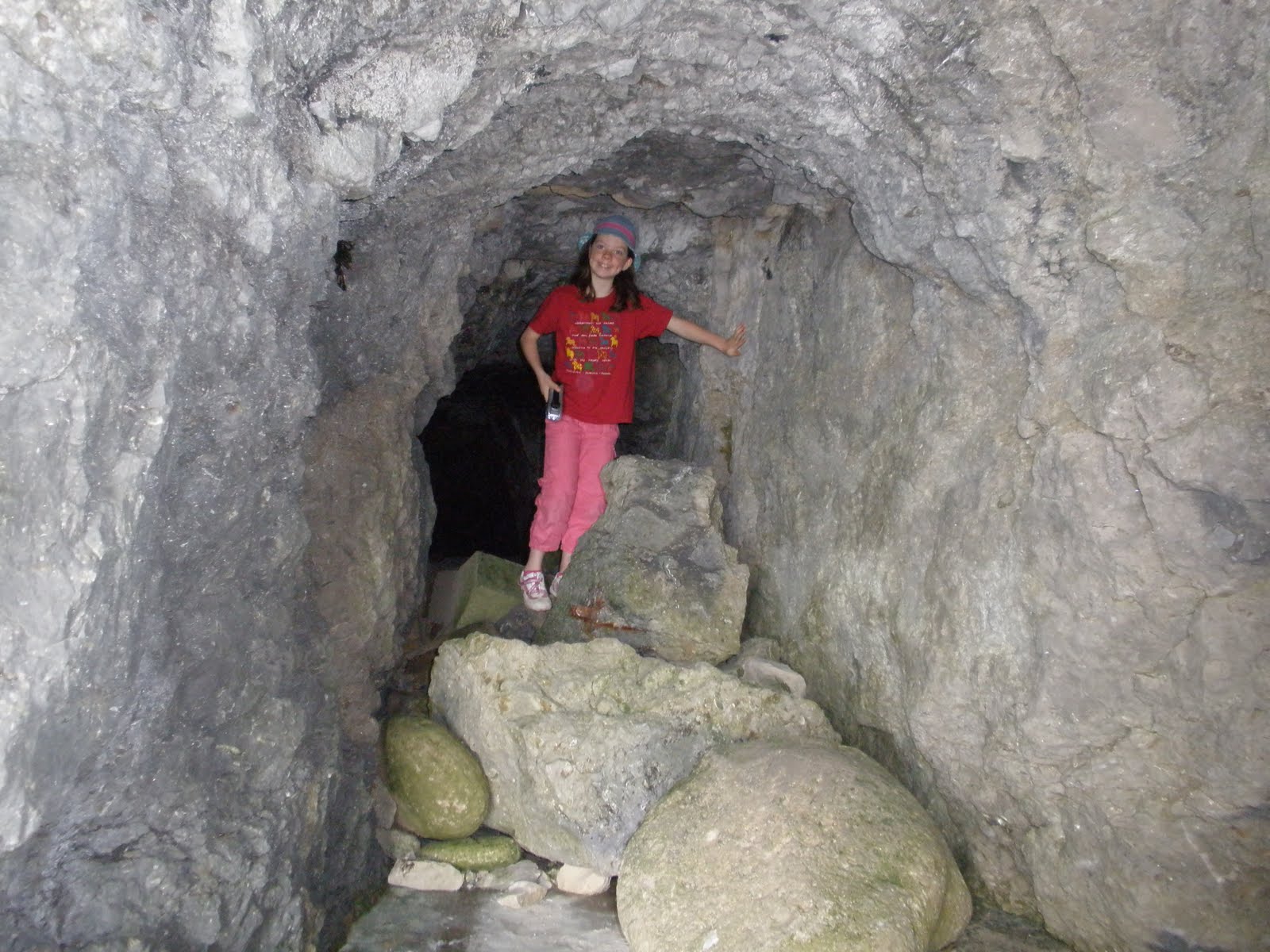
I took the kids rockhopping over to the Smugglers Cave. It looks like no more than a crack in the cliff face from a distance, but when we slipped inside we found this tunnel, hewn into the solid rock.


t was very dark and we scrambled and bumped our way over the boulders with only our torches to light our way.

After a while the tunnel took a 90 Deg turn and suddenly ended at this shaft.


I told the kids that this was where the smugglers brought their booty ashore and stored it. The people in the house at the top of the shaft were in on it and used to use the shaft to bring the contraband to the surface on dark stormy nights when there was nobody about to watch their illegal activities. There they would load it onto carts to take to the mainland. And they never got caught ... until one day a young girl.....

I think that's much more exciting than being a service tunnel for the old pump that was used to supply water to the naval base, don't you?

Tuesday, 20 July 2010

Guest Author: David Bridger.


Please welcome today’s guest, David Bridger. David’s debut novella ‘Beauty and the Bastard’ has just been released as an e-book from Liquid Silver Books

Hello David, Welcome to the Scribbling SeaSerpent.

Thank you for inviting me to the Scribbling Serpent, Kate. It's a pleasure to be here.

Please could you tell us a bit about ‘Beauty and the Bastard’?

Beauty and the Bastard is a paranormal romance novella about a dangerous love in dangerous times, involving a tortured fallen angel who works as a bounty hunter for powerful urban demon families, and the modern-day demon princess he is hired to protect when those who mean her harm get too close for comfort.

What draws you to Paranormal Romance?

I love paranormal romance, and her brother genre urban fantasy, for their dark and delicious danger. I love the battered and bruised characters who strive to find light in the darkness against all odds and most people's better judgement. And I love the coolness of it all. These are very cool genres.

The e-book market is fairly new. How do you see it evolving?

The ease of self-publishing via ebooks and POD has exploded the potential for every man and his dog to put their stuff out there. But I honestly don't believe this huge wave of self-published (and largely unedited, and therefore quite often rubbish) books will pose any threat to anyone. I don't think it will do much of anything, really, except just sit there.

The only authors who will thrive in that medium are the ones who would thrive anyway - or who are already thriving. Good writers, in other words, many of whom are already published and who are extending their reach via self-publishing.

Professionally published ebooks come from two different segments of the industry.

There are the ebook-first ones, such as those from a small group of well-established and very succesful epublishers of the various romance sub-genres. My publisher is one of them. In my opinion, these guys have it sussed. Their authors and readers are respected, well-treated and happy, and who can ask for more than that?

Then there are the traditional publishers who are trying to muscle in on the ebook market, mostly through fear. Their sweaty desperation is clear to see, and they're throwing their weight around the same way they always have. If they had any common sense and really wanted to learn how to succeed in the electronic market, they would study how dedicated epublishers go about their business. But I won't hold my breath on that one.

Do you need to buy and e-book reader in order to enjoy an e-book?

No. I don't have one, but that doesn't stop me from buying about 50% of the books I read from epublishers. I'm quite comfortable reading on my PC screen, actually, and I use my netbook as an ereader when I want to take a proper break from the computer.

So how does it feel to be published?

Absolutely bloody brilliant!

Honestly, I'm over the moon. I was about to trot out the "words fail me" phrase just then, but that's even less true right now than it usually is. So I'll dam the enthusiastic river and just say: it's wonderful.

Can you tell us about your journey to publication?

I always wanted to writing novels when I came home from sea eventually, but I didn't expect that homecoming to happen traumatically and in my early thirties. I was badly injured and it took me several years to regain movement and mobility. Learning how to write novels helped me stay sane during that long process.

And once I thought I'd cracked the creative learning bit, when my first novel was complete and I thought I was ready to start learning the business side of writing, that's when I really started to learn.

Joining a good writing community was an invaluable step in the right direction at that point, as was finding and joining other communities along the way and, later again, teaming up with my wonderful crit partners. Without those most excellent people, I'd still be stumbling around in the wilderness.

So what else do you have in the pipeline?

I'm writing another paranormal romance at the moment. It's set in the same world as Beauty and the Bastard, but features a new cast of characters. I love it!

Thankyou David for stopping by. And you can buy Beauty and the Bastard here.

http://www.liquidsilverbooks.com/books/beautyandthebastard.htm

Monday, 12 July 2010

What Happened at Frome

Yesterday I attended the Words at Frome Writers and Publishers Day at the Frome Library. It was the first time I had attended on of these events and it was a fascinating experience – I talked to some interesting people and learned quite a bit along the way.

Anyway, I thought I would share some of my experiences with you.

Well Frome is quite a trek for me to get to – there’s no easy route, so it was a good thing I hadn’t already bought a ticket for the first talk because I would have missed most of it. Still, chilling out after the long drive in the sunshine with a coffee was rather pleasant and everyone there seemed to be very friendly.

A group of self published authors were setting up a stall nearby and it wasn’t long before I was chatting to them. Now I don’t buy self published books as a matter of principle. I’m sure there are some good ones out there but when I’ve bought one in the past (usually more to be polite because I know the person) I’ve always been disappointed and I don’t think I’ve ever finished one.

So these guys kept telling me about their books and handing them to me and I kept putting them back down, After a while one of them frowned at me and said:

“You’re not going to buy anything are you?”

To which I’m afraid my answer was “No.” But all credit to them they took it in good heart and were an interesting bunch of people to talk to.

Then I managed to hook up with a couple of people I do know. Well, one person I know in real life from my real life writers group and the other a friend from Cyberspace – Journeygirl from Litopia. It can be strange meeting up with other Litopians – staring at someone wondering if they fit the description they’ve given you, but for some reason we recognised each other the moment our eyes met. And she’s a scientist too!! Yay – let’s hear it for women in science!

But I digress. Back to the festival:

I attended two talks.

The first was the short story prize giving, which I went along to with my writing group buddy. The overview of the stories was very interesting, but two things stood out immediately. First the fact that a number of the shortlisted stories had been sent off to women’s magazines and the second was when the lady giving the summary went through her pet hates in a short story – you know the sort of stuff – telling not showing, inconsistent POV, bad grammar and spelling and Science Fiction.

Yup, you heard me. SF was on the pet hates list.

When she said that my friend and I rolled our eyes and looked at each other. Oh dear. Well at least we now know why our entries didn’t get anywhere.

In fact all the shortlisted stories were very much in the women’s fiction genre, and I also noticed that there wasn’t a single man amongst the finalists!

I think that’s really quite telling!

Since I don’t write women’s fiction I don’t think I’ll enter this one again.

The second talk was on how to get an Agent for your Children’s Book given by – yes – you guessed – an Agent. It was an excellent talk packed with useful advice. I sat there, frantically scribbling notes (and noticed the woman beside me was doing the same.) I just hope I can read my own handwriting.

And of course, I had a 1:2:1 with said Literary Agent. But I’ll tell you all about that next time.

So all in all, my first foray to one of these events was an excellent experience –. I was quite nervous but everyone was so welcoming. Bring on the next one! I’ll be there.

And if you’ve never ventured to one of these yourself then do it! You won’t regret it!

Monday, 5 July 2010

Analysis: The Thieves of Ostia by Caroline Lawrence

This is the first novel in the Roman Mysteries series. I picked it up in an offer in Waterstones and gave it to my daughter to read since they were doing the Romans in school at that time.

She devoured it, worked her way through all the subsequent stories that were published, and then waited eagerly for each new volume to appear dragging me into town so that I could buy it for her. So I thought I’d better read one of them to find out what it was that gave them their appeal. Actually I’ve read a few of them because they’re really rather good, but I’m just going to concentrate on the first one here.

This is a wonderful book that really brings Ancient Rome to life – you can almost taste the figs and smell the dusty streets. And it’s a good story – an adventure mystery set in the ancient world.

But what I think gives this book its appeal is the characters. We have Flavia, a well bred Roman girl, her slave Nubia, Jonathan the Jewish boy next door (who is really a Christian) and Lupus the deaf mute beggar boy. These are a group of characters that are really well drawn and authentic, that the reader really empathises with and cares about. They have great depth and each of them reflects an aspect of Roman society. They drive the story forwards and when the novel ends you don’t want to leave them.

My analysis: Engaging Characters

http://www.romanmysteries.com/pages/50-Home_Page